Click on QR Code to read the Humanure Handbook for free. It will download the Table of Contents, which will be linked to the individual chapter PDF downloads.
Or just click here to read the Humanure Handbook 4th edition for free (PDF).
Compost toilets can provide a sanitation solution when water or electricity are not available, or when you simply want to make more compost or less environmental pollution.
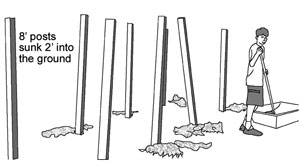
Post
holes were dug and 3 inch by 4 inch black locust posts were set
in a mixture of dry concrete and soil, moistened and
packed down.
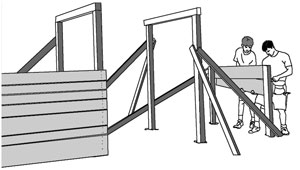
With
the posts set and braced, black locust boards are screwed
to the posts to provide the bin's walls.
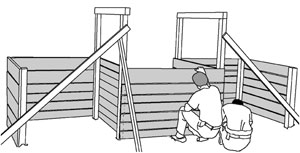
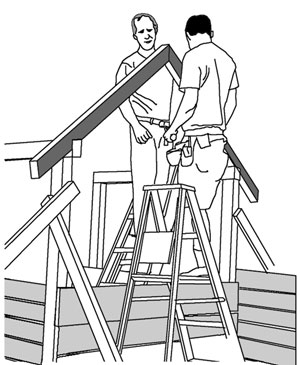
The
bins take shape as more boards are added to the sides
(above). Rafters, made of recycled hemlock, are cut by
Joe Jenkins and step-son Brent Ulisky and notched with
a bird's mouth to rest on the horizontal beams (below).
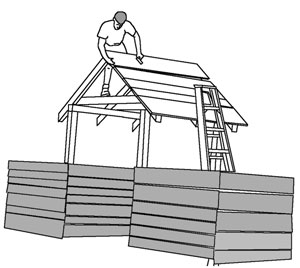
Salvaged
boards from a demolished barn serve as sheathing for
the roof (above). Note the 20 year old humanure compost
bin in the background, built for nothing out of recycled
materials, but now getting a bit dilapidated.
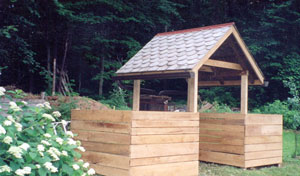
The
sheltered middle bin, used to store cover materials,
is roofed with reclaimed slate. You can just see the
top of a sawdust pile behind the Hacienda (left side
of photo). The sawdust is used in the toilet system.
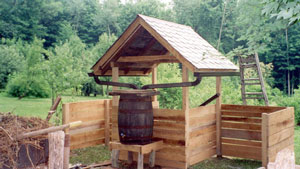
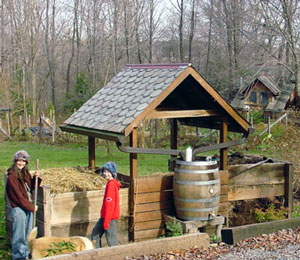
Gutters
and downspouts route rainwater into a collection barrel
(above). The rainwater is used to clean compost buckets.
The rinse water is deposited on the compost pile.
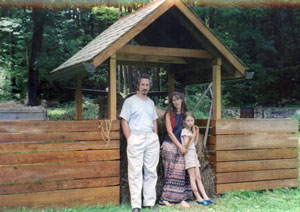
The
Humanure Hacienda, newly built (below).
Steaming compost pile (below). This pile was being dug and videotaped by the same person at the same time - shovel in one hand and camera in the other, so it's a little shaky.
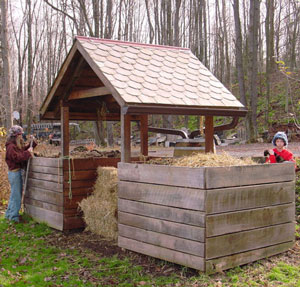
The
Hacienda after 2 years of use (below). Note location
of house and garden in left photo. House is behind
the compost bins and to the right, garden is behind
and to the left. Chicken house slate roof is visible
at edge of garden (far left of top left photo, in back). Despite
the fact that the compost bins are filled with toilet
material, there is no odor whatsoever emanating from
this composting system. The right bin contains aging compost
from the prior year. It will be used in the following
spring and the active (left) bin will then be put to
rest for a year (becoming the aging bin). The cycle
continues in this way indefinitely. You can read more
about it in the Humanure Handbook.
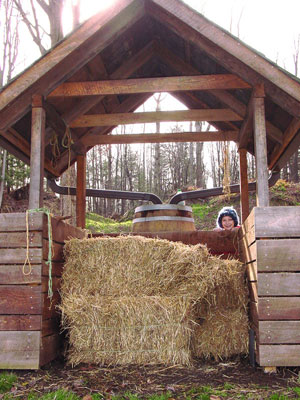
Center
bin is used for storage of cover materials (above); in
this case, hay bales for the winter.